




Press
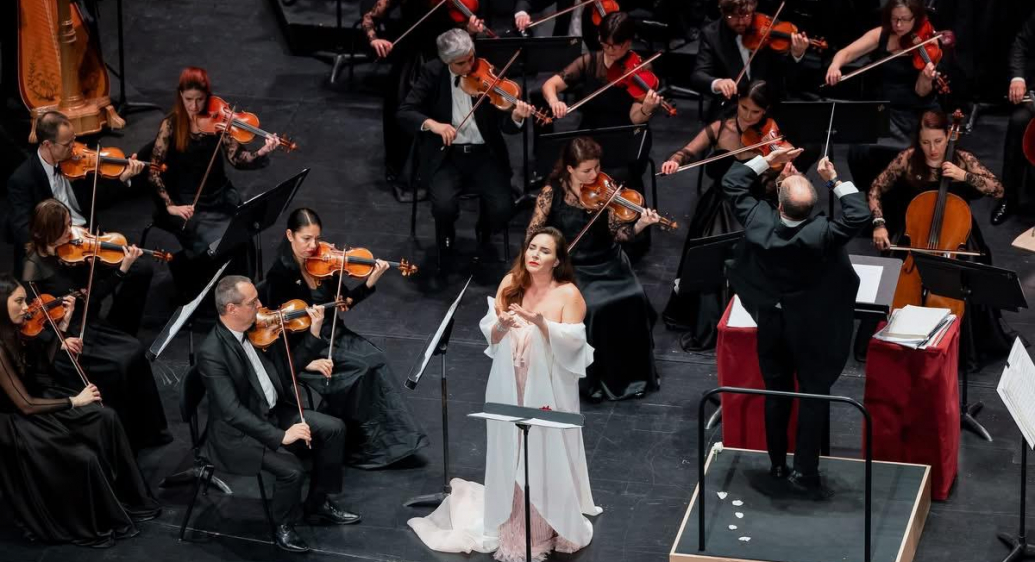
Press review concert at Théâtre des Champs-Élysées
““Non ti scordar di me” (“Do not forget me”), Yoncheva sings at the very start of the concert, in Anna’s romance from Puccini’s Le Villi. The audience seems determined to reassure her of precisely the opposite, responding with sustained enthusiasm after each of her appearances. Snow clearly did not deter the soprano’s many admirers from filling the Théâtre des Champs-Élysées, their shouted acclamations and bouquets of roses testifying to their loyalty.
Before receiving an armful of flowers, Yoncheva appears holding a white rose, plucking its petals as she measures the days separating her from her beloved in the aria. She moves across the stage, letting the train of her violet gown flow freely, with an air of abandon. Pink and white will follow in the second half. From the outset, the voice impresses with its ease, equally assured in supported low notes and in gleaming high registers rich in harmonics. (…)
Her French is impeccable in the Massenet arias, including “Il est doux, il est bon” from Hérodiade, as well as in Bizet’s Carmen Habanera, for which she now wears a red rose. The middle register here is velvety and resonant, naturally engaging the chest voice without excess.
For Yoncheva, Dvořák’s “Song to the Moon” from Rusalka ranks among the most beautiful pages ever written for soprano. She brings to it the full range of her artistry, from hushed murmurs to boldly projected high notes, shaped by a smooth legato and sustained by a warmly vibrating tone.
(…)
After a prolonged ovation, Yoncheva returns for an encore with the Italian song “Non ti scordar di me” by Ernesto De Curtis, neatly closing the circle. Not quite, however. When the audience calls for Verdi, the soprano replies that she has something better. Sharing her love of the French language, she launches into Édith Piaf’s “La vie en rose.”
Frédérique Épin, Ôlyrix
“The combined effect of a programme largely focused on Puccini and an irradiant stage presence, Sonya Yoncheva’s concert at the Théâtre des Champs-Élysées at the opening of the 2026 season was above all a moment of warm communion between one of the great stars of today’s operatic circuit and an audience inevitably won over from the outset.
A languorous diva takes to the stage, almost as if in a fully staged performance, a white rose in hand, which she slowly plucks apart during “Se come voi piccina” from Puccini’s Le Villi. An early work, still raw in its writing, it already allows Sonya Yoncheva to display an opulent timbre and a finely sculpted line. Her interpretation is enriched with soft colors and beautifully shaded piani. (…) These qualities and her strong theatrical instinct infuse each aria of the concert, at times flirting with mannerism, but more often hitting the mark – particularly in the aria from Massenet’s “Hérodiade”, which the Bulgarian soprano performs regularly in concert. The first half concludes with a shivering “Donde lieta uscì,” in which the burnished colour of the voice bathes the scene in an aura of melancholy, followed by Rusalka’s Prayer to the Moon, sung at an extremely expansive tempo.
“… the Manon Lescaut intermezzo reveals everything Puccini demands: differentiated timbres and tonalities, a diaphanous harp, and a transparency that allows each orchestral section to emerge with clarity. The two Bulgarian pieces – one symphonic (Thracian Dances by Staynov) and the other taken from a scene of the opera Albena by Parashkev Hadjiev, sometimes dubbed the “Bulgarian Puccini” – concentrate all these qualities. In them, Sonya Yoncheva demonstrates her proven gifts as a tragedienne.
Carmen’s Habanera concludes the programme, this time with a red rose in hand, in the same vein: theatrical in every sense of the word. Two encores (Non ti scordar di me and La vie en rose) follow, offered to thank an audience that was as attentive as it was enthusiastic.
Yannick Boussaert, Forum Opera
“She moves languorously in a billowing violet gown, adjusts her diamond bracelet, and steps to the front of the stage while plucking the petals from a white rose. Sonya Yoncheva is more than a diva. She is a star.
Despite the snow, unreliable transportation, and the usual early winter flu season, audiences made the effort to come out for the Bulgarian diva, lured by the promise of ninety minutes of verismo and blazing Romantic heroines, enough to forget the hassles of the journey and the January blues.
That sense of escape begins almost immediately, from the opening bars of Puccini’s Le Villi, which set the dramatic tension that shapes the evening’s choice of arias. From a betrayed fiancée to a fallen courtesan, from biblical seductresses to classic femmes fatales, the Bulgarian soprano offers her Parisian audience a carefully mastered repertoire, familiar territory with little real risk, yet delivered with the virtuosity for which she is known.
With a sensuous voice whose velvety timbre holds firm even in the lowest register, and a fragility that is more apparent than real, Yoncheva does not need to overpower the orchestra. It is enough to suggest that she could. Through finely judged phrasing and articulation, she highlights words that feel almost whispered, evoking torment one moment and passion the next, before releasing steely high notes.
In Massenet’s “Il est doux, il est bon,” one of the most moving pieces on the program, the soprano displays clear diction and impressive breath control in the final high notes, guided by a sure sense of tragedy. “Donde lieta usci” from La bohème convinces less, though the languor of the tone remains, reminding the audience that Yoncheva truly reveals the full scope of her talent in complete operatic performances.
The first half closes with the famous “Song to the Moon” from Rusalka, one of the evening’s most beautiful moments. The aria highlights Yoncheva’s mastery of nuance, her vocal power seeming almost too vast for this ardent prayer. Under Nayden Todorov, the orchestra brings out the colors of the young nymph’s hopeful longing, while Yoncheva sustains her plea to the moon in a carefully shaped crescendo, ending the final phrase with intensity rather than letting it fade on a long breath. The effect is striking, and offers an enticing preview of her role debut in Dvořák’s opera later this year.
(…)
The Bulgarian arias in this second half therefore bring welcome freshness and the pleasure of discovery, notably Petko Staynov’s “Rachenitsa,” with its delightfully folkloric rhythms, and the charming “Albena” by Parashkev Hadjiev.
It is impossible to miss the intention to pay tribute to the French language and to the local audience, as Yoncheva herself notes at the end of the recital when she thanks the hall for its warm welcome to the Sofia Philharmonic Orchestra, impeccable throughout, and to its conductor, whose rapport with the singer infused the evening with good spirits and lightness. Two essential ingredients for closing a concert that may hold few surprises but is undeniably indulgent, capped by two encores: De Curtis’s “Non ti scordar di me” and the iconic “La Vie en rose.” A true star has a star’s repertoire, and always knows how to show grace toward her audience.”
Ivar Kjellberg, Première Loge
“A beautiful concert with a great soprano, and a wonderful way to begin the year.”
MHG. Chemin de la scène