




Press
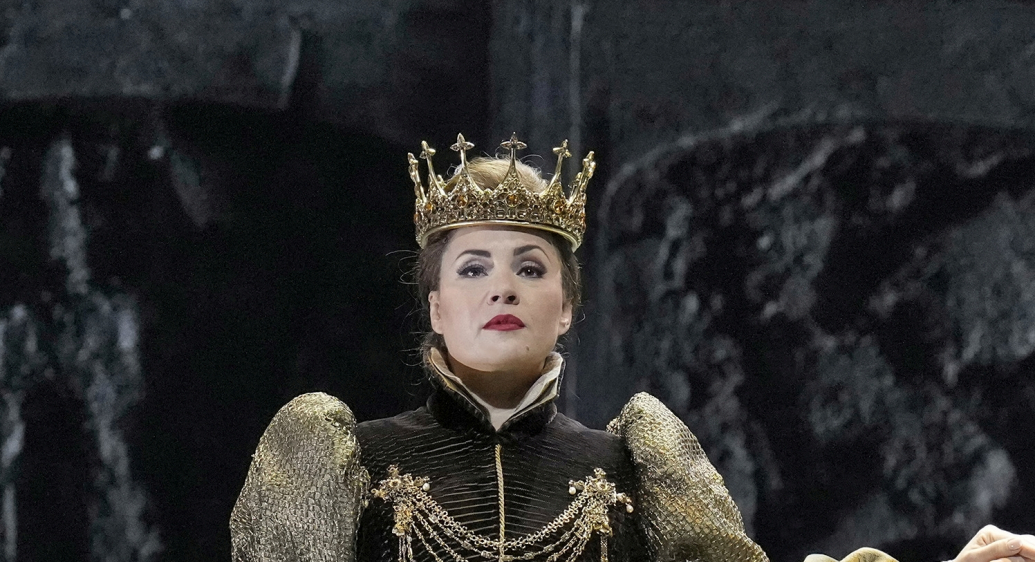
Sonya Yoncheva is “an exquisite Elisabeth” at the Metropolitan Opera
Sonya Yoncheva is currently on the stage of the Metropolitan Opera in the company’s first ever performances of the five act version in French of Verdi’s Don Carlos as “an exquisite Elisabeth” (The Washington Post), clothing the role “in silver and damask” (New York Magazine). You can find the complete press review here below:
“The Bulgarian soprano Sonya Yoncheva made an exquisite Elisabeth, her voice lithe and light, a satin softness that could sharpen into a blade. She masterfully sustained the new queen’s tension between duty and desire — and when she collapsed, you felt it snap.”
Michael Andor Brodeur, Washington Post
“Sonya Yoncheva is lovely as Elisabeth de Valois who, destined to marry Carlos, is constrained instead to marry his father, Philip, devastating both the young lovers.”
George Loomis, The Financial Times
“… her slender, focused voice penetrates, and it fits her interpretation of the character as coolly dignified, even chilly, enough to endure the sacrifices she has made.”
Zachary Woolfe, The New York Times
“… Sonya Yoncheva’s distinct, moonbeam soprano…”
Harry Rose, Observer
“The marvelous soprano Sonya Yoncheva clothed the role of Élisabeth in silver and damask…”
Justin Davidson, Vulture (New York Magazine)
“… simple, direct singing in a bel canto performance of “O ma chère compagne” and in the Act V duet with Carlos.”
William R. Braun, Opera News
“Sonya Yoncheva, on her part, has all that is needed for the role of Élisabeth, of which she offers one of the most beautiful interpretations in recent years. The high register, characterized by an irresistible youthful light, is not that of the matronly sopranos who weigh down the character, the formidable low register is perfectly placed. With a supreme phrasing and rich with endless nuances, she distills an emotion of each moment.
Vincent Agrech, Diapason
“Elizabeth was Sonya Yoncheva, the Bulgarian soprano star. She didn’t sing like a star. Let me explain that. Yoncheva can be a diva and a half. As Elizabeth, she was all regality and dignity. She projected a quiet femininity, subject to injury but ultimately strong. I have seldom seen or heard a soprano so touching in this role.
On Broadway, they speak of an “11 o’clock number”—a showstopper that really wakes them up, or keeps them awake. Don Carlos has an 11 o’clock number too. The show started at 6:30, and Elizabeth sang “Tu che le vanità” at about 11. Sonya Yoncheva did the number justice.”
Jay Nordlinger, New Criterion
“In the demanding role of Élisabeth de Valois, daughter of Henri II of France, betrothed unseen to the Infante but later married to King Philippe, Sonya Yoncheva delivers splendidly, exhibiting imposing tone and gorgeously round middle voice. Her huge Act Five solo is a highlight in an evening filled with many.”
Susan Stempleski Classical Source
“Soprano Sonya Yoncheva played the role of Elisabeth not so much as a helpless victim of circumstances, but as a defiant and wilful woman. She negotiated her tricky final aria with delicate pianissimos while retaining warmth in her middle voice. She was elsewhere an effective presence on stage and in voice.”
Ako Imamura, Bachtrack
“…she made such a rich impression that she virtually became a centerpiece of the opera. I remember first hearing her in OTELLO and suggesting it be renamed DESDEMONA; I had similar feelings here. She had many opportunities to shine in the opera, but her Act V aria, “Toi qui sus le néant” (better known as the Italian, “Tu che le vanità”), was certainly a highlight for me.”
Richard Sasanow, Broadway World
“More than once, Élisabeth de Valois asserts that she is the daughter of a king, and Sonya Yoncheva made that readily apparent in her regal bearing. She sang with consummate artistry and sumptuous tone, instilling her Élisabeth with both nobility and a haunting sense of melancholy.”
Rick Perdian, Seen and Heard International
“Yoncheva was a fine pairing with Polenzani, her rounded voice carrying different shades against his bright clarity. In general she sang with a slightly understated strength, pacing the character’s development through the five acts. When she reached her Act V aria, “Toi qui sus le néant,” she had built a deep foundation of expression, and her musical artistry—inflection, emphasis, phrasing—was beautiful.”
George Grella, New York Classical Review
“… the cast was almost completely successful, both on the part of the francophone (an extraordinary Étienne Dupuis), of the French by adoption (Sonya Yoncheva)…”
Extraordinary Étienne Dupuis and Sonya Yoncheva
As soon as she entered the stage, in a superb white dress, Sonya Yoncheva looked like a Queen. She has the bearing of a Queen, she also has the manners, she has the speech. She inhabits every word of it until this “Yes” whispered when forced to give her answer on her marriage to Philippe II. As we already know, the artist never engages in this form of pretentiousness that characterizes some of her colleagues who use effects to dazzle us. Of course, those who expect a Diva are at their expense, but what sets this great artist apart is a truth, an accuracy, an appropriation of the character.
In this Don Carlos, Sonya Yoncheva is the woman who goes through the hardships imposed on her; she is the Queen, she is “the mother”, she interprets her great arias in a way that is as rigorous in singing as in gesture. What authority and what mastery when she has to manage Carlos’ outbursts while thinking of the reason of state! What an art of gesture, when she resists the wanderings of love by gently placing her hand on this dreamy Carlos’ head! What an illusion of intimate abandonment she is able to demonstrate with luminous high notes in the final scene!
From all this ensemble stems a fair art, drawn in perfect straight lines, residing in the simplicity of an exceptional performer.”
Paul Fourier, Toute La Culture
“On this evening Sonya Yoncheva and Matthew Polenzani portrayed the lovers. During the Fountainbleau scene, Polenzani and Yoncheva sang with gorgeous pianissimo sounds and beautiful mezza voce. (…) But by the time, the second duet in Act two, “Je viens solliciter de la reine,” came along, both singers brought their passion to the scene. Meanwhile, Yoncheva’s tone was an imposing and round middle voice. But as they entered into the middle of the duet their voices brought back that gorgeous mezza voce singing from that first duet, blending it beautifully with the angelic violins in the orchestra. The voices answered each other with ardor and pain and as the duet came to its climax, there was a confrontational aspect to their singing. Polenzani was all intensity as he accented each line, climaxing on a very aggressive “Fils maudit.” Yoncheva retorted that he kill his father and carry her to the alter with his “blood-stained hands” with chilling power before scaling her voice to a restrained but anguished “Signour.” It was in this duet that we saw these two character’s complex relationship come to fruition and the tension built here carried throughout the drama.
The final duet in Act five was sung with resignation as the two used their floating mezza voce sounds to sing the parting legato phrases. The voices blended beautifully as they both embraced for one final “Adieu.”
Individually there was so much to admire about Yoncheva’s performance as she gave Elisabeth a regal interpretation. (…) Yoncheva’s first aria “Oh ma chère compagne” was sung with an angelic and tender voice that displayed the soprano’s flexibility in her middle and her upper range. And in her “Toi qui sus le néant,” the soprano was commanding as she entered the stage and let out her weeping lines with crisp diction and a booming middle voice. As she remembered Fontainebleau, the nostalgia seeped into the instrument with great care and delicacy. During her reprise of the opening melody, there was resolve as she drove the tempo forward and ended with a gorgeous piano line.”
Francisco Salazar, Opera Wire
“His (Polenzani’s) chemistry with Yoncheva was excellent and the combination of their timbres was very pleasant to the ear. This chromatic blend, together with the fine projection of both singers in the high register, gave life to very balanced and stylized duets. The Bulgarian soprano was successful as Isabel de Valois, more discreet in her acting than Polenzani, but very concentrated and communicative. Sonya Yoncheva skillfully engaged herself in the most challenging parts, finding pleasure in the width of her mid and low register, and a little more just when she had to sail to the top register. Yoncheva opted for a somewhat conservative and chamber music approach that allowed her to shine in her interventions… . (…) her timbrical beauty and the sweetness of her ligne du chant… .”
Carlos Javier López Sánchez, Opera World
“Her sad, proud queen found Sonya Yoncheva in one of her most congenial Met roles. … her plangent, covered tone revealed Élisabeth’s thwarted hopes ever so movingly especially in her three wrenching duets with Polenzani.”
Christopher Corwin, Parterre
“… it is a beautiful voice and she uses it tellingly. A victim of so many circumstances, she is nonetheless no cipher here. Yoncheva’s Elisabeth grows into a tragic figure, her farewell to her Lady-in-Waiting in the first act was still and sad; her last-act “Toi qui sus le néant” was epic and received a deserved ovation.”
Robert Levine, Classics Today
“Sonya Yoncheva’s plush, noble sound made for a regal Elisabeth. … she sang with elegance, sensitivity, and dignified power. She was at her most moving in the consoling aria “O, ma chère compagne” (Oh, my dear companion) and in the final duet with Don Carlos.”
Maria Cristina Necula, Woman Around Town
[Photo: Ken Howard / Met Opera]